Dominate Soccer This Pre-Season
Author: Jayme Pantekoek
Don’t Just Show Up—Dominate Soccer This Pre-Season
Getting ready for the upcoming season is about more than just showing up in shape. Soccer is a fast, explosive, repeat-effort sport. Players need to be able to sprint, recover, change direction, and do it again, without breaking down as fatigue sets in.
The athletes who handle pre-season best usually are not starting when pre-season begins. They come in with a plan. Building sprint capacity, improving sprint technique, preparing the body for the demands of the game, and staying consistent with training can give players a real advantage before the season even starts.
This is exactly why registering for the FAST Pre-Season Performance Camp matters, it gives players a structured way to build the speed, strength, movement quality, and repeat-effort capacity this article shows are essential before the season begins.
Building Sprint Capacity for Soccer
Sprint capacity is your ability to perform repeated sprints during a game or tryout. Soccer demands quick bursts of speed over and over again. Improving sprint capacity means you can run close to top speed multiple times without a major drop-off in speed or output.
This is not just about being fast one time. It is about building the ability to repeat high-intensity efforts and recover well enough to do it again.
To build sprint capacity, use Repeat Sprint Ability workouts like we do at FAST Athletics. For example:
- Sprint 10–20 yards at full speed, then slow down gradually after the sprint
- Walk back to the start for recovery
- Repeat 6–10 times with 30–45 seconds rest between sprints
Do this 2–3 times per week and gradually increase the number of sprints over time. This helps prepare your body for the demands of a soccer game or a long tryout day.
Improving Sprint Technique for Better Speed and Efficiency
Sprint technique is how you run, your posture, foot placement, arm action, and timing. Good technique helps you reach top speed faster and use less energy while doing it. That means you can sprint more efficiently, recover quicker, and stay more dangerous as the session or match goes on.
Key points to focus on:
- Keep a low body angle early to create forward drive
- Focus on low foot recovery so you do not over-reach
- Stay long with your arm action straight forward, not across your body
- As you approach top speed, let your body gradually become more upright
- Stay powerful in your strides and turn your legs over fast
- Strike the ground cleanly with the balls of your feet
- Stay relaxed at top speed and do not fight against your own body
Practicing sprint drills like A-skips and bounding can help improve form. You can also film yourself running, as we do at FAST Athletics, to identify technical areas that need work.
Better technique reduces wasted energy and helps players reach breakaway speed more effectively.
Injury Prevention Through Movement and Strength Training
One of the biggest mistakes athletes make is waiting until team training to expose their body to sprinting, cutting, decelerating, and repeated high-intensity movement. When the body is not prepared for those demands, injury risk goes up.
As muscles fatigue, joints and tendons take on more stress. That can lead to strains, sprains, or other avoidable issues.
Strength training helps protect the body by improving the muscles’ ability to absorb force, stabilize joints, and control movement. Instead of relying on bones, joints, and tendons alone, trained muscles help handle the impact of sprinting, stopping, landing, and changing direction.
Strength work also improves how the nervous system responds during movement. A more prepared nervous system helps the body stabilize faster and react better under stress, especially around the knees, ankles, and shoulders.
You can use strength and movement work as part of your warm-up progression:
- Start with squat and lunge holds and slower deep muscle movements to activate muscles and tendons without impact
- Progress to A-skips, low bouncing, and dynamic movement to prepare the body to be more reactive
- Finish with plyometric drills like tuck jumps and bounding to improve reactivity and ground force handling
These same ideas can also be used in cool downs after training or games to restore movement quality and re-activate ranges of motion that may have been affected by fatigue or contact.
Consistency in Training
Consistency is one of the biggest factors in long-term development and short-term performance. Players who train with purpose over time are better prepared for an intense season than players who wait and try to rush the process right before the first week of games.
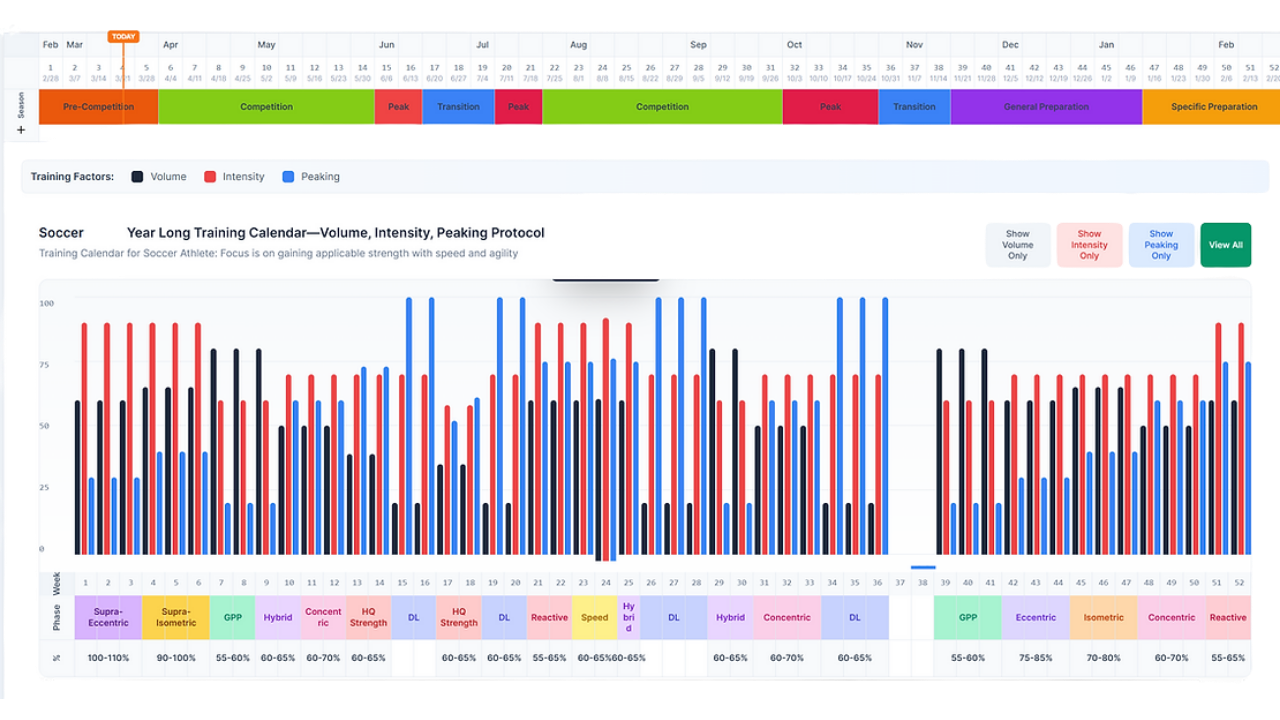
Following a structured yearly calendar helps athletes build, adapt, and peak at the right times.
A simple approach can look like this:
Off-Season: Aim for 2–3 training sessions per week. This is the best time to focus on strength, speed, and explosivity.
Pre-Season: Maintain 2 training sessions per week. This is where players start sharpening what they built in the off-season and preparing for the specific demands ahead.
In-Season: As match demands increase, shift to 1 training session per week once high-intensity games begin. This helps maintain speed and strength while allowing for recovery and performance.
Having a yearly plan also helps athletes stay committed to development. When players pull back too much on speed and strength training, it becomes harder to rebuild that momentum later. In many cases, they return behind where they were.
Below is an example of how you can schedule your athletes' year-round training calendar. This shows what times of the year the athlete wants to peak, this means volume is low and intensity is high. We can use this information to better assess training frequency, intensities and volume.
Mindset, Nutrition, and Hydration Tips
Physical preparation matters, but so does how you show up mentally and how well you fuel your body.
Your mindset can affect your performance more than many athletes realize. Before the season starts, identify a few focus points. What do you want to do well? If you make a mistake during the session, take a breath, reset, and move on. The best players are not perfect—they recover quickly and stay focused on the next action.
Nutrition should stay simple and intentional.
- About 5 hours before training or games, eat a balanced meal with protein, carbs, and fat
- About 2 hours before, shift more toward carbs
- About 1 hour before, keep it mostly carbs with little fat or protein
- About 10 minutes before, use a quick glucose source like applesauce or a sports drink
- During breaks, continue using easy carbs if needed to maintain energy
Hydration should be steady throughout the day. Drink water consistently before and during training or games. Save sugary drinks for quick energy when needed during breaks.
Take Pre-Season Training Seriously
Soccer pre-season is not just about getting active again. It is about preparing for the actual demands of the game.
Being in decent shape is not the same as being ready to sprint repeatedly, recover quickly, move efficiently, and hold your level as fatigue builds. Players who take pre-season seriously give themselves an advantage before the season even begins.
Building sprint capacity, improving sprint mechanics, preparing the body through strength training, and staying consistent with your schedule can all help you perform better and stay healthier as the season approaches.
If you want to be ready when the moment comes, do not wait for pre-season to start your preparation
Ready to Prepare the Right Way?
If you want a structured program to help you prepare for the upcoming soccer season, consider joining a training group that focuses on speed, strength, and movement quality. At FAST Athletics, we build programs designed to help soccer players improve sprint ability, develop strength, and prepare for the real demands of the game.
The goal is simple: show up fast, strong, confident, and ready to perform.